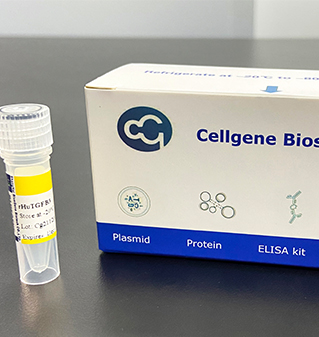
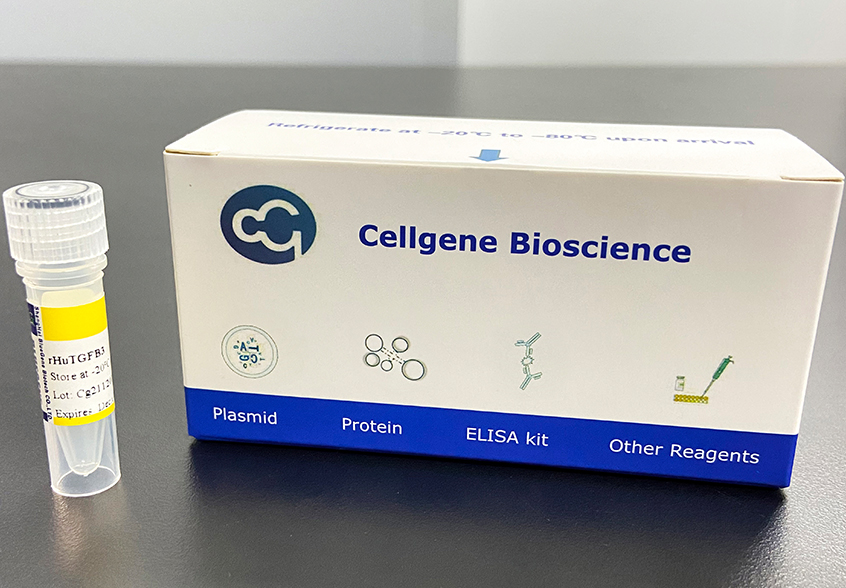
Fibroblast Growth Factor 2 (FGF2) can also be called BFGF; FGFB; FGF-2; HBGF-2.
Specifications Of P01F0003P-T2 Human Fibroblast Growth Factor 2 (FGF2) Protein, Recombinant
| Product Information | |
Catalog Number | P01F0003P-T2 |
Package Size | 10ug/50ug/500ug/1mg |
Other Names | BFGF; FGFB; FGF-2; HBGF-2 |
Protein & NCBI Number | D9ZGF5, NM_001361665.2 |
Host | E.coli |
Express Region | Met1-Ser155 |
Protein Sequence | MAAGSITTLPALPEDGGSGAFPPGHFKDPKRLYCKNGGFFLRIH PDGRVDGVREKSDPHIKLQLQAEERGVVSIKGVCANRYLAMKEDGRLLASKCVTDECF FFERLESNNYNTYRSRKYTSWYVALKRTGQYKLGSKTGPGQKAILFLPMSAKS |
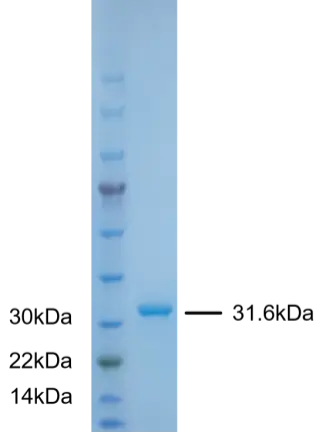
Molecular Weight | The protein consists of 281 amino acids (including the fusion tag), with a predicted molecular weight of 31.6 kDa, |
Fusion Tag | 6×His-SUMO (N-terminus) |
Purity | ≥95% SDS-PAGE |
Physical Property | Liquid |
components | 0.01M PBS+20% glycerol, sterile solution. |
Storage & Stability | After aliquoting, the stability of the samples can be maintained for up to 6 months |
Applications | Antibody preparation, immunoassay (ELISA, WB), subcellular localization and interaction protein identification, etc. |
Lead Time | 5 to 10 business days; 2 to 3 days for stock products |
| Bioactivity | .jpg "HuFGF2_有标(1).jpg") .jpg "HuFGF2_有标(3).jpg") |
Background |
FGF-2, also known as basic fibroblast growth factor (bFGF), is an important member of fibroblast growth factor (FGF) family. FGF-2 is a cationic polypeptide with a molecular weight of 16 ~ 18000 and an isoelectric point of 9.6. FGF2 can be produced by vascular endothelial cells, retinal pigment epithelial cells, photoreceptor cells, m ü ller cells and astrocytes. It widely exists in a variety of tissues in vivo and mainly plays a role through autocrine and paracrine. The signal pathway induced by FGF2 is necessary for normal cell growth and differentiation. It exists in almost all cells. FGF2 binds to FGFR, which makes the receptor dimerize and tyrosine kinase is activated, triggering a series of intracellular phosphorylation cascade reactions to regulate cell growth Differentiation and apoptosis. Under normal conditions, FGF-2 binds to heparin and does not produce biological effects. However, in some pathological cases, the integrity of cells is destroyed, which can release the stored form of FGF-2, promote angiogenesis and participate in the process of tissue repair. FGF-2 and FGFR are almost distributed in various tissues of the whole body. FGF-2 is the strongest known cytokine. It plays an important role in promoting angiogenesis, wound healing, tissue injury repair, neuroprotection, embryonic development and tumor formation. FGF-2 has two main functions, inducing endothelial cell germination and proliferation and increasing vascular permeability. In addition, studies have shown that FGF2 is also closely related to depression. |
Related Products Of Human Fibroblast Growth Factor 2 (FGF2) Protein, Recombinant
P01F0003P Human Fibroblast Growth Factor 2 (FGF2) Protein, Recombinant
P01I0420P-T2 Human Insulin-like Growth Factor 1 Long R3 Analog (IGF1-LR3) Protein, Recombinant
P01E0032P Human Epidermal Growth Factor (EGF) Protein, Recombinant
P01V0016E-T3 Human Vascular endothelial growth factor 165 (VEGF165) Protein, Recombinant
P01F0073P-T2 Human Fibroblast Growth Factor 9 (FGF9) Protein, Recombinant
P01I0420P Human Insulin-like Growth Factor 1 Long R3 Analog (IGF1-LR3) Protein, Recombinant
P01E0032P-T2 Human Epidermal Growth Factor (EGF) Protein, Recombinant
P01F0221P-T2 Human Fibroblast Growth Factor 10 (FGF10) Protein, Recombinant