Human Interleukin 3 (IL3) Protein, Recombinant
Introduction:
Interleukin-3 (IL-3), also known as Multicolony Stimulating Factor (Multi-CSF), has been referred to by various names in earlier studies, including Burst-promoting Activity (BPA), WEHI-3 Factor, Mast Cell Growth Factor(distinct from stem cell factor, SCF), Histamine-stimulated Cell Growth Factor, P-cell Stimulating Factor, and Pluripotent Colony-stimulating Factor.
IL-3 is primarily produced by activated T cells and NK cells. Additionally, IL-1-activated human endothelial cells, IgE-activated murine mast cells, and placental cells can also pruduce IL-3. Its primary function is to stmulate the proliferation and lineage-specific differentiation of multipotent hematopoietic stem cells in the bone marrow, thereby generating various types of blood cells. Furthermore, IL-3 plays a regulatory role in the growth, differentiation, and gene expression of multiple mature cell types, including genes such as c-myc and IL-2Rα. Interleukin-3 (IL-3) exerts its biological function by binding to the IL-3 receptor on the cell surface, which consists of an α subunit (CD123) and a β subunit (CD131). IL-3 plays a pivotal role in immune regulation, inflammatory responses, and hematopoietic reconstitution. Its expression is markedly upregulated under conditions of infection, stress, or tissue injury, thereby enhancing immune response and tissue repair. Moreover, IL-3 acts synergistically with other cytokines such as GM-CSF and IL-5 to drive the expansion and differentiation of hematopoietic progenitor cells, supporting the generation of multiple blood cell lineages.
Activity assay protocol:
.jpg "Recombinant_(2).jpg")
The biological activity of the protein was evaluated using TF-1 human erythroleukemia cells through a cell proliferation assay, with an ED₅₀ of 0.238–0.323 ng/mL, demonstrating excellent lot-to-lot consistency.
For benchmarking, a comparative study was conducted against recombinant proteins available on the domestic market. All experimental procedures were performed under a standardized SOP, and the analytical results are summarized as follows:
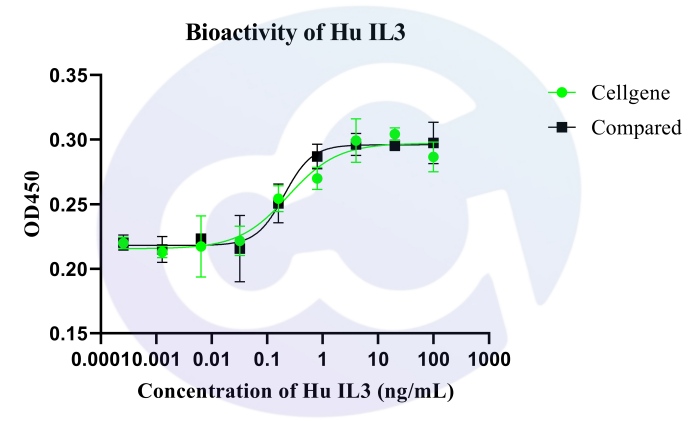
Based on four-parameter logistic (4PL) curve fitting analysis, the ED₅₀ of Cellgene’s protein was determined to be 0.238 ng/mL, while that of the competitor protein was 0.203 ng/mL, indicating comparable activity levels between the two.